If you run a restaurant, café, takeaway, hotel kitchen or any other commercial kitchen with gas equipment, sooner or later someone will ask to see your gas safety certificate. It might be your insurer, your landlord, an environmental health officer or a client you cater for.
This guide explains what the law requires, what a commercial catering gas safety inspection (often called a CP42, after the form many engineers use) actually involves, the most common reasons kitchens fail, and how to prepare so your inspection causes as little disruption as possible.
The short answer
- The law requires you to keep your gas appliances, pipework, flues and safety devices in a safe condition. An annual inspection by a Gas Safe registered engineer who is qualified for catering equipment is the accepted way to show you're doing that.
- The inspection covers your gas pipework, every appliance, the safety devices on each appliance, your ventilation and canopy, the gas interlock system and your emergency isolation valve.
- The most common problems are interlocks that are missing, faulty or bypassed, older equipment without flame supervision, worn flexible hoses and poor ventilation.
- Not every Gas Safe engineer can work on catering equipment. Check that their ID card shows catering under the non-domestic section.
Is a commercial gas safety certificate a legal requirement?
Strictly speaking, no law says "you must hold a CP42". But the law does put a clear duty on you.
Under regulation 35 of the Gas Safety (Installation and Use) Regulations 1998, employers and the self-employed must make sure gas appliances, flues, pipework and safety devices at their workplace are maintained in a safe condition. The Health and Safety Executive's guidance for catering businesses says annual inspections are a reasonable minimum, unless the manufacturer recommends more frequent servicing.
In practice, the inspection record is how you prove you're meeting that duty. Without one, you'll struggle to satisfy:
- your insurer, who may refuse a claim if gas equipment hasn't been maintained
- your landlord or managing agent, whose lease will usually require it
- environmental health officers, who check that gas equipment is maintained during their visits
- clients and contract caterers, such as schools, care homes and venues, who ask for it before you start work
If your premises include residential accommodation, such as rooms above a pub, a hotel or staff accommodation, the landlord gas safety rules also apply to those areas. That means an annual check and a record given to the occupants.
What a commercial catering gas inspection covers
A proper inspection is much more than a quick look at the cooker. Your engineer should check:
- The gas installation pipework. A tightness test proves there are no gas escapes between the meter and your appliances. Commercial kitchens are tested to the IGEM standard that matches the size of the installation.
- Every gas appliance. Burners, flame picture, ignition, controls, gas pressure and, where fitted, flues.
- Flame supervision devices. These cut off the gas if a flame goes out. Every burner on modern equipment should have one, and they're tested to make sure they shut off as they should.
- Flexible hoses and restraints. Hoses on moveable equipment are checked for damage, kinks and correct length, and the restraint chain or cable is checked so the hose can't be pulled when the appliance is moved for cleaning.
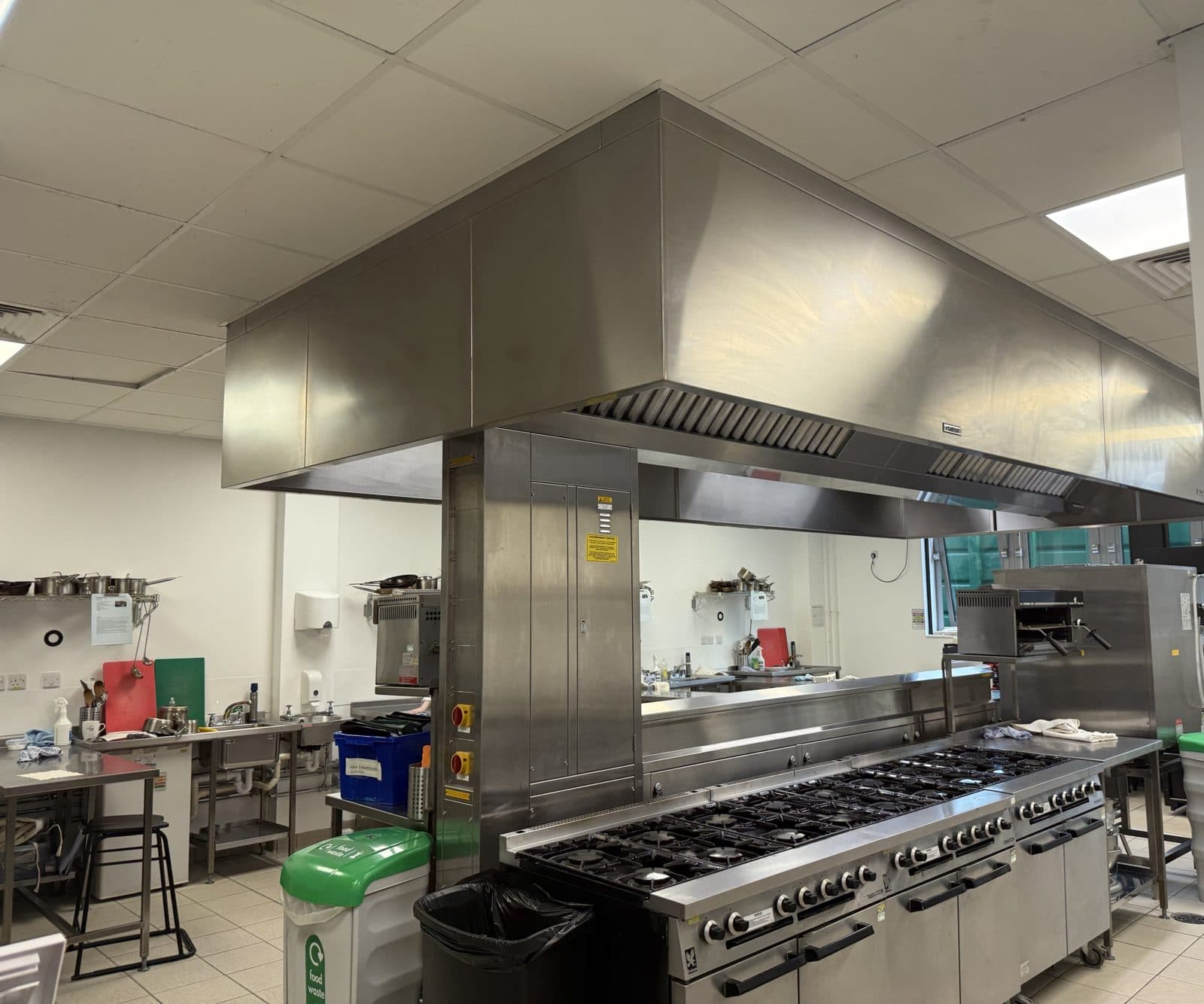
- Ventilation and the canopy. The extraction has to remove fumes and the kitchen needs a permanent supply of fresh air for the burners. Windows and doors don't count.
- The gas interlock system. If the extraction fails, the gas to the appliances must shut off. The interlock is tested to prove it does exactly that.
- The emergency isolation valve. There should be a valve, or an emergency stop button, that staff can reach quickly to shut off the gas to the kitchen, with a notice beside it.
- Air quality. Many engineers take a carbon dioxide reading in the kitchen with the equipment running, as a check that the ventilation is coping.
At the end, you get a written record of each appliance, the test results and any defects found.
Gas interlocks explained
A gas interlock links your gas supply to your ventilation. If the extract fan stops, or isn't switched on, the interlock closes a valve and cuts off the gas to the cooking equipment. Without one, burners can keep running with no extraction, and carbon monoxide and other combustion products can build up quickly in a busy kitchen.
Many interlock systems also include gas proving. Before the gas is restored, the system checks that no burner has been left open, so gas can't flow into the kitchen unnoticed.
Do you need one?
HSE guidance says that where a kitchen has mechanical ventilation, an interlock should be fitted so that ventilation failure shuts off the gas, and that manual bypasses of interlock systems are not permitted. The British Standard for installing gas catering equipment, BS 6173, sets out the detail.
BS 6173 isn't retrospective, so an older kitchen without an interlock isn't automatically unsafe. But it isn't automatically fine either. Where there is no interlock, the risk has to be assessed and controlled, and in most cases the sensible answer is to fit one. New installations, new equipment and kitchen refits are the natural time to do it.
The most common interlock problem we see
Bypassed interlocks. A fan switch taped on, a link wire across the controls, or a "temporary" override that's been in place for years. They're usually done to stop nuisance shutdowns, but they defeat the whole purpose of the system and will be recorded as a defect at inspection. If your interlock keeps tripping, there's a reason, and the fault should be found and fixed.
What about carbon dioxide monitoring?
Some kitchens use carbon dioxide (CO2) monitoring linked to the gas supply. Systems are typically set to warn staff at around 2,800 ppm and shut off the gas at around 5,000 ppm. Industry guidance is that CO2 monitoring shouldn't be relied on as the main interlock signal in most kitchens. Proving that the fans are actually running is the primary safeguard.
Why commercial kitchens fail their gas inspection
These are the problems that come up most often:
- Missing, faulty or bypassed interlocks. See above.
- No flame supervision on older or second-hand equipment. Ovens and open burners without flame failure devices need upgrading or replacing.
- Worn or poorly fitted flexible hoses. Perished, kinked, dragging on the floor, too short, or no restraint fitted.
- An emergency isolation valve that's hidden, seized or unlabelled. Often boxed in, behind stock, or in a different room.
- Poor ventilation. No permanent fresh air supply, blocked or greasy filters, or a canopy that doesn't cover the equipment underneath it.
- Second-hand equipment fitted without proper commissioning. A bargain range or fryer can turn into an expensive problem if it isn't suitable for the site or is missing safety devices.
- Gas escapes on the pipework. Old joints, damaged pipe or redundant pipework that was never properly capped.
- Yellow, lifting or noisy flames. Usually a sign of dirty burners, incorrect gas pressure or poor air supply, and a carbon monoxide risk.
What happens if something fails?
Gas engineers follow the Gas Industry Unsafe Situations Procedure. If something is found to be unsafe, it's classed as either:
- Immediately Dangerous: a present danger to life or property. The appliance or installation is disconnected from the gas supply.
- At Risk: one or more faults could become dangerous. With your permission, the appliance is turned off.
In both cases the appliance is labelled "Danger, do not use" and you're given a written warning notice. It must not be used until it has been repaired and retested. Faults that aren't unsafe but don't meet current standards may be noted on your record as advice.
A failed appliance in a busy kitchen is a real problem, so where we can, we fix faults on the same visit and plan bigger repairs around your service times.
Who is responsible: landlord or tenant?
If you run the kitchen, the duty to keep the appliances you use in a safe condition sits with you as the employer. Your lease then decides who looks after the rest: the gas supply pipework, the ventilation system, the canopy and the interlock. In many commercial leases, the tenant is responsible for all of it.
Read your lease, and if it's unclear, agree in writing who arranges and pays for the annual inspection and any remedial work. Whatever the lease says, the kitchen shouldn't be operating on equipment that hasn't been checked.
Pre-inspection checklist for kitchen managers
A bit of preparation makes the visit quicker and avoids a second trip:
- Book the inspection for a quiet period. Appliances have to be turned off for the tightness test and interlock checks.
- Make sure the engineer can reach the gas meter, the emergency isolation valve, the interlock control panel and the back of every appliance.
- Clean the canopy filters and have your most recent ductwork cleaning record to hand.
- Find your previous gas safety record, service records and any interlock commissioning certificate.
- List any equipment that's been added, moved or replaced since the last inspection, especially anything second-hand.
- Write down any problems staff have noticed, such as pilots going out, yellow flames, interlock trips or a smell of gas.
Simple checks your staff can do every day
Between inspections, a few daily habits catch problems early:
- Flames should burn blue and steady, unless the manufacturer says otherwise.
- Burners should light cleanly, with no delayed ignition or popping.
- Extraction should be switched on before cooking starts and left running until the equipment is off.
- Air vents and fresh air intakes should never be blocked.
- Flexible hoses should hang in a smooth curve, not twisted or trapped, with the restraint connected.
- Every member of staff should know where the emergency isolation valve is and what to do if they smell gas.
If anyone smells gas, turn off the supply at the emergency isolation valve, open doors and windows, don't operate electrical switches, and call the National Gas Emergency Service on 0800 111 999.
Not just restaurants
The same rules apply to any commercial kitchen with gas equipment, including:
- school and nursery kitchens
- care home kitchens
- church halls and community centres
- golf clubs, sports clubs and social clubs
- hotel and pub kitchens
- staff canteens in offices, factories and warehouses
In many of these buildings, the kitchen is just one part of the gas installation, alongside boilers, water heaters and warm air heaters. We can inspect the whole site on one visit, so you have one set of records and one renewal date.
How Titan Heat can help
We carry out commercial catering gas safety inspections across Glasgow, Lanarkshire and Central Scotland. That includes:
- annual gas safety inspections with a written record for each appliance
- interlock testing, fault finding and repair
- tightness testing and gas leak repairs
- repairs to catering equipment and safety devices
- planned maintenance contracts, so inspections and servicing happen on schedule without you having to chase them
Use our commercial enquiry form to tell us about your kitchen, how many gas appliances you have and when you're quietest, and we'll arrange a visit and give you a clear quote.
Frequently asked questions
Is a CP42 a legal requirement?
There's no law that names the CP42 form, but you are legally required to keep gas equipment at work in a safe condition. An annual inspection record is the accepted way to prove it, and most insurers and landlords insist on one.
How often does a commercial kitchen need a gas safety inspection?
At least once a year, or more often if the equipment manufacturer recommends it. Busy kitchens often benefit from servicing more frequently than the annual inspection.
Can any Gas Safe engineer inspect my kitchen?
No. Commercial catering work needs specific qualifications. Check the engineer's Gas Safe ID card: catering should be listed under the non-domestic section. You can also check on the Gas Safe Register website.
Can my kitchen stay open during the inspection?
Partly. Appliances need to be off for the tightness test and the interlock checks, so it's best to book a quiet period or before service starts.
My kitchen doesn't have a gas interlock. Will I fail?
Not automatically. The engineer will assess the risk. If there's no interlock, you'll usually be advised to fit one, and if there are other problems with the ventilation, it may be recorded as a defect. Any new installation or major refit should include an interlock.
Do I need a carbon monoxide alarm in the kitchen?
HSE guidance is that any CO alarm in a commercial kitchen should be a commercial-grade unit, not a domestic one, and ideally linked to shut off the gas. An alarm is a warning device only. It doesn't replace good ventilation, a working interlock and regular maintenance.
What's the difference between a CP42 and a CP12?
A CP12 is the landlord gas safety record for rented homes. A CP42 is the record many engineers use for commercial catering inspections. If you have both a commercial kitchen and residential rooms, you may need both.
Do you cover my area?
We carry out commercial gas work across Glasgow, Lanarkshire and Central Scotland.