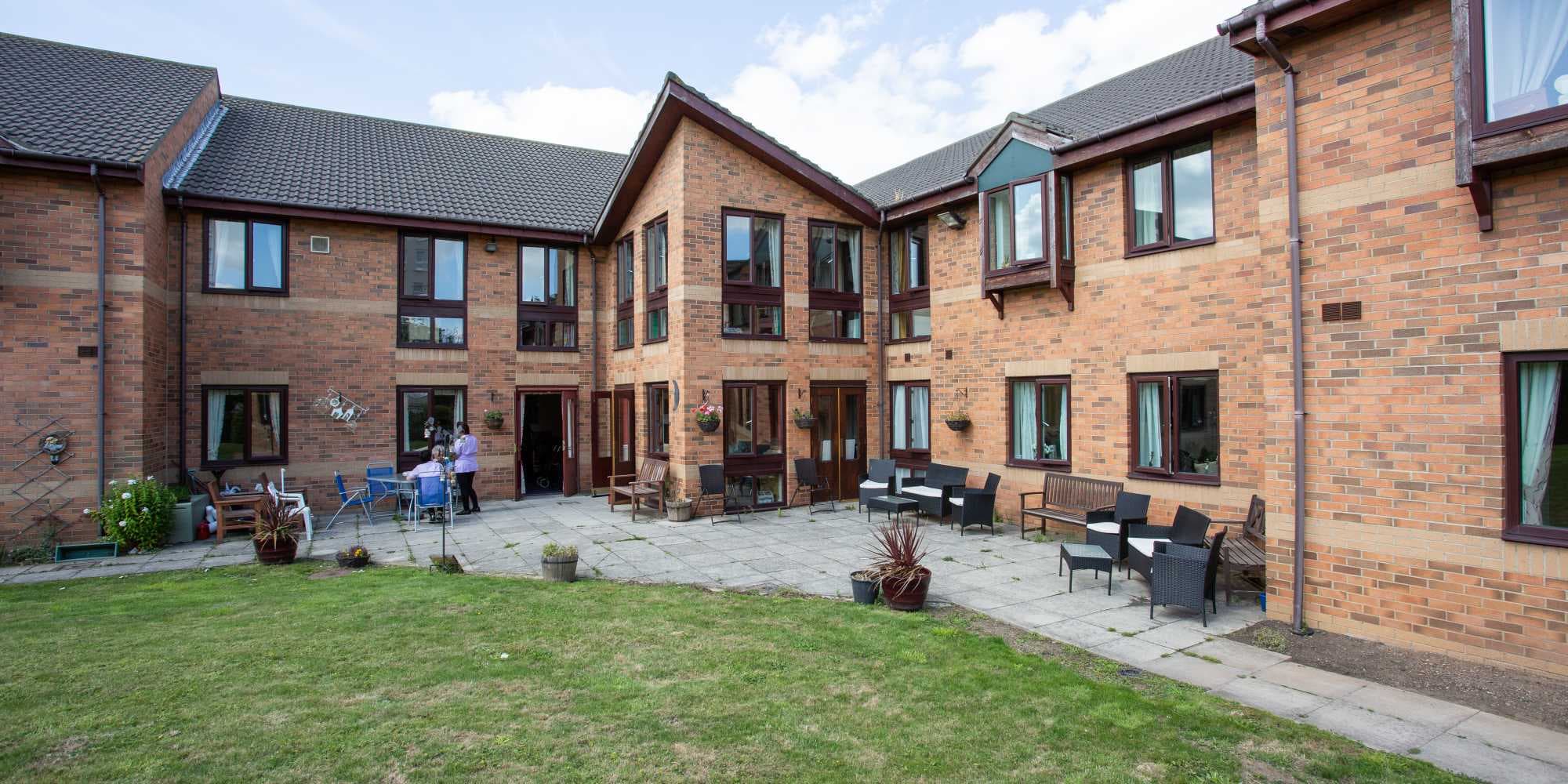
A lot of commercial boilers get replaced in a hurry. Something fails in January, the part turns out to be obsolete, and a school, care home or office ends up on hired heat while a new plant room is designed against the clock. It doesn't need to go that way.
This guide is for facilities managers, business owners, property managers, school bursars and church treasurers looking after an ageing plant room in Glasgow, Lanarkshire or elsewhere in Central Scotland. It covers when replacement makes sense, the main design choices, the Scottish rules, what drives the cost and how to plan the work so the building keeps running.
The short answer
- Replace when the boiler is unsafe, parts are no longer available, breakdowns keep coming back or repair bills keep climbing. A single fault on a sound boiler is usually a repair.
- Most replacements now use a cascade of modular condensing boilers with a low loss header or plate heat exchanger. You keep heat if one boiler fails, run more efficiently at part load and get an easier lift into the plant room.
- In Scotland, a gas boiler over 70 kW net input, or work on a chimney or flue pipe (other than a balanced flue), isn't covered by the no-warrant exemptions, so a building warrant is usually needed. Exempt work must still meet the building standards.
- New gas boilers up to 400 kW must meet Ecodesign efficiency rules, which in practice means condensing. A bigger boiler bank may also need a bigger gas supply.
- Scotland's clean heat legislation is still a draft Bill, not law. Designing for lower flow temperatures keeps your options open.
- Survey in spring, install in summer, and budget for flushing, water treatment, controls and removing the old plant, not just the boilers.
Signs it's time to replace a commercial boiler
It's rarely one thing. Look for a combination of these:
- Parts availability. The manufacturer no longer supplies heat exchangers, burners or control boards, and parts are being sourced second-hand.
- Repeat breakdowns. Several call-outs in one winter, or the same fault returning.
- Warning notices. A boiler classed as Immediately Dangerous or At Risk can't be used until it's put right. If the fix is a major component on an old boiler, replacement often makes more sense.
- Poor efficiency. High gas bills, high flue gas temperatures on the service sheet and simple on/off firing from an old non-condensing boiler.
- Rising service costs. Each service report lists more remedial work, such as leaking cast iron sections, corroded flues or tired burners.
- The building has changed. An extension, change of use or lower occupancy has left the plant oversized or undersized.
If you smell gas, call the National Gas Emergency Service on 0800 111 999. Signs of carbon monoxide include headaches, dizziness, nausea and tiredness that ease away from the building, staining around a boiler or flue, and a CO alarm sounding. Turn the plant off, ventilate and have it checked by a Gas Safe registered engineer before it's used again.
Repair or replace? A fair way to decide
A safe boiler with parts available is usually worth repairing, and nobody should sell you a new plant room over one failed fan. Equally, money spent on a boiler that's on borrowed time is money you won't see again.
- Will it be safe once repaired? Points to repair: Yes, with a straightforward fix. Points to replace: Only with a major component on an old unit.
- Are parts available? Points to repair: From the manufacturer, at a known price. Points to replace: Obsolete, second-hand or long lead times.
- How often has it failed? Points to repair: First significant fault in years. Points to replace: Every winter.
- Repair cost against replacement? Points to repair: A small fraction. Points to replace: A large share, with more to come.
- What if it fails again? Points to repair: Other boilers can carry the load. Points to replace: It's the only boiler in a care home, school or hotel.
Get a proper diagnosis first. If you've been told a boiler is beyond repair, ask for the fault and the parts position in writing. Our commercial boiler repair visits start there.
Like-for-like or a cascade of modular boilers
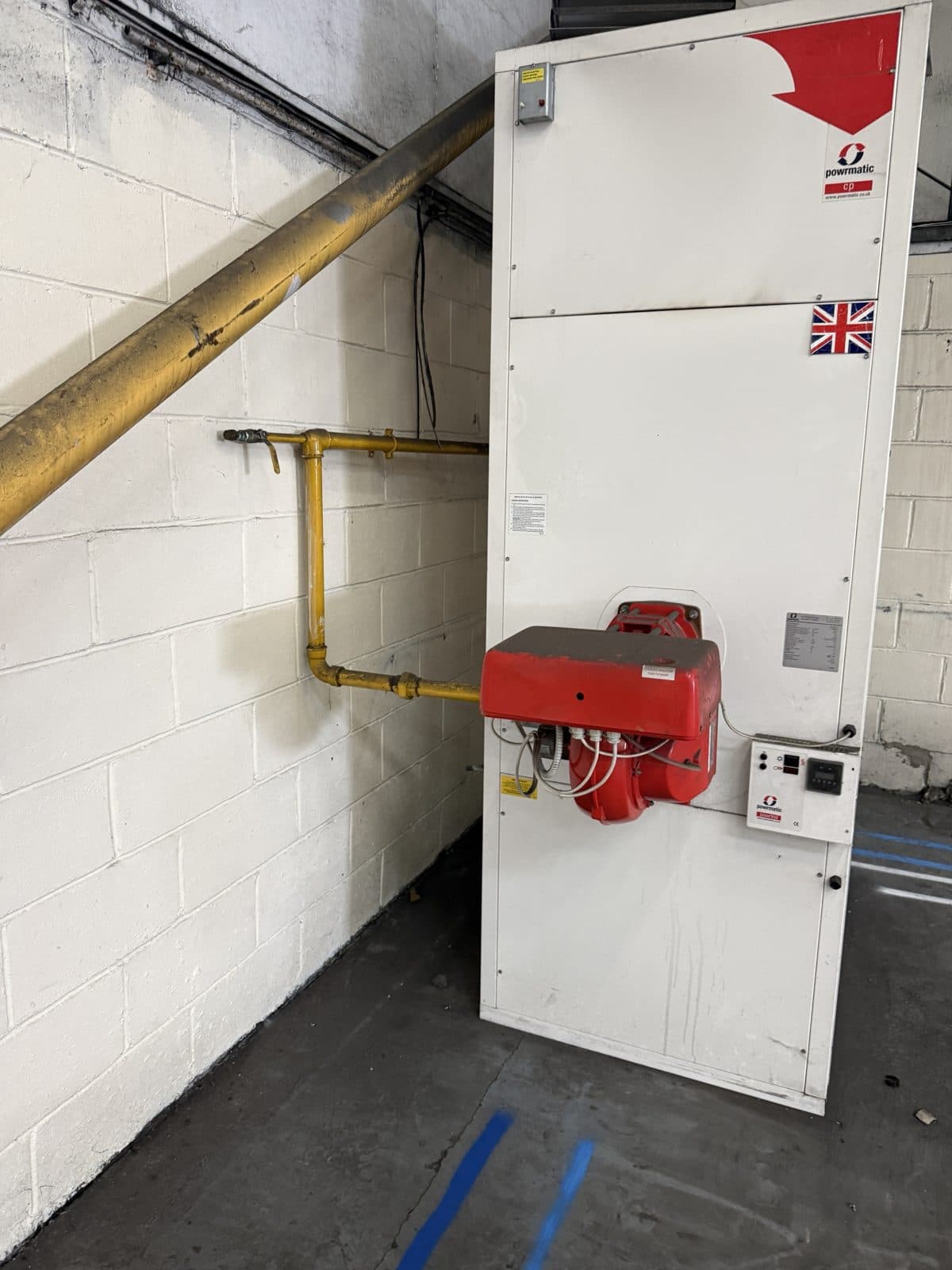
Older plant rooms often have one or two large floor-standing boilers, usually cast iron sectional or steel shell. A modern floor-standing condensing boiler in the same position can suit larger buildings with good access, but one boiler still means no heat when it fails.
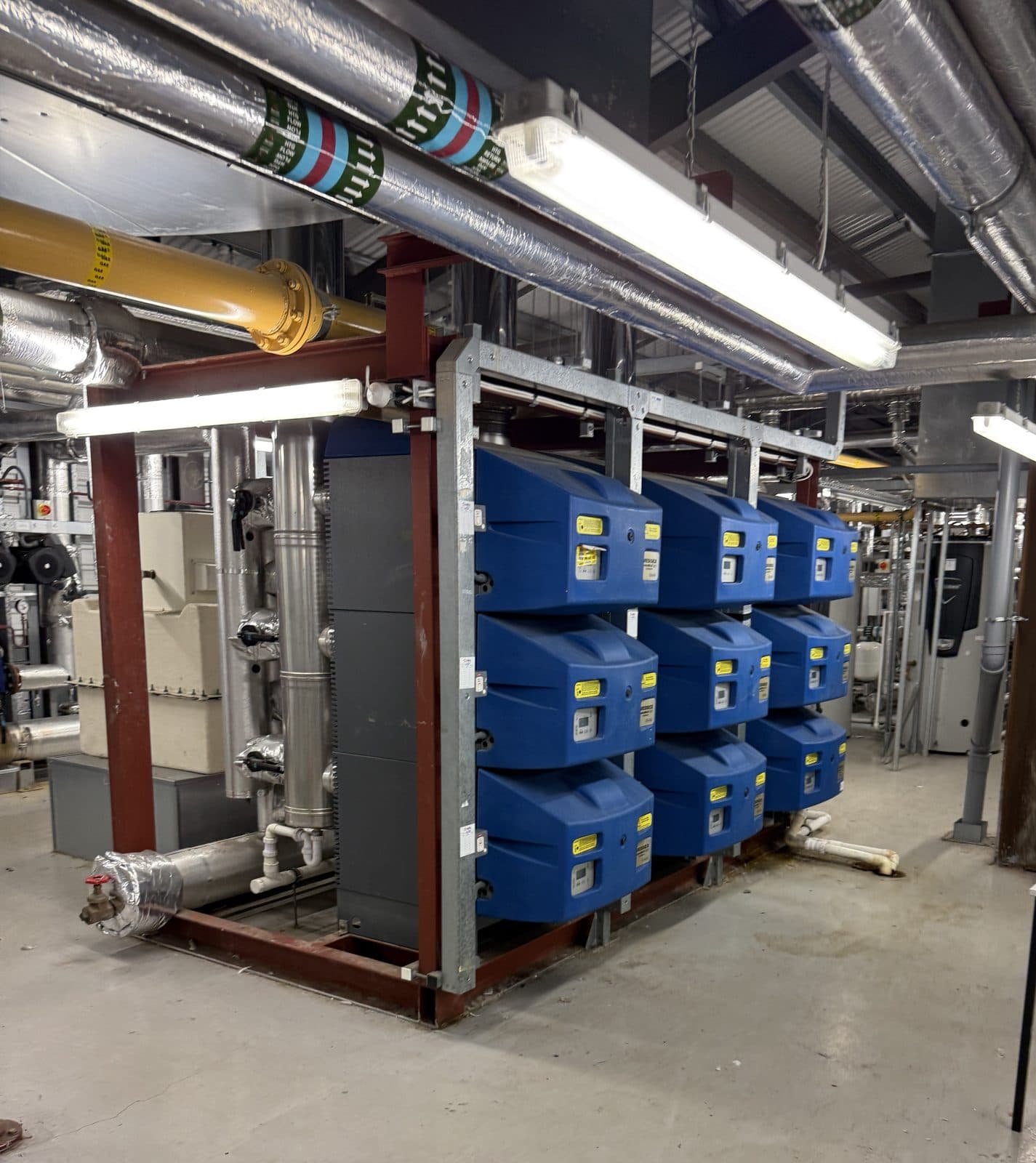
A cascade is a bank of smaller boilers, wall-hung or on a floor-standing frame, run by a sequence controller that fires only as many as the load needs. Cascades are now the usual choice in schools, care homes, offices and churches because they offer:
- Redundancy. If one module fails, the rest keep the building warm.
- Turndown. Several small modulating boilers match a low load far better than one big one, so there's less short cycling and more time condensing.
- Footprint and access. Modules are small and light. In a basement plant room down a narrow stair, common in older Glasgow buildings, that can mean carrying boilers in rather than craning them through a wall.
- Phasing. Where space allows, new modules go in while an old boiler keeps running.
The trade-off is that cascades have small, low water content heat exchangers that don't tolerate dirty water or poor flow, and the controls and any common flue header need careful design.
The parts that matter as much as the boilers
Hydraulic separation
Most manufacturers want cascade boilers separated from the heating circuits so boiler pumps and system pumps don't fight each other. A low loss header, ideally with dirt and air separation, suits systems that can be properly cleaned. A plate heat exchanger keeps boiler water and system water apart, which helps where old pipework can't be cleaned well or can't take the pressure the new boilers need.
Pressurisation and expansion
Plenty of older buildings in Glasgow and Lanarkshire, from Victorian churches to 1960s schools, still run open-vented systems fed from a tank in the roof. Most modular condensing boilers need a sealed system, so expect a pressurisation unit and expansion vessels sized for the system volume, after checking the old pipework, radiators and valves will take the pressure. Ask your insurer's engineering inspector whether any new vessels belong on your written scheme of examination under the Pressure Systems Safety Regulations 2000.
Cleaning and water treatment
Sludge and magnetite from an old system will quickly block a new heat exchanger, and manufacturers can refuse warranty claims where the water wasn't treated. Glasgow's soft water keeps limescale down, but corrosion debris still builds up. BS 7593:2019 is often quoted, but it's a domestic code that excludes commercial premises. For commercial systems the usual references are BSRIA's BG 29 (pre-commission cleaning) and BG 50 (water treatment for closed systems). In practice: a suitable chemical clean and flush, a dirt separator, the right inhibitor and water sampling at handover and during maintenance.
Controls and hot water
Expect a sequence controller that rotates the lead boiler, weather compensation and time and zone control that match how the building is used. In a church hall used a few days a week, that can save as much as the boilers. Where there's a BMS, the new plant should report status and alarms to it. Electrical work is carried out through our approved, separately registered contractor.
If the plant also heats hot water, decide early between an indirect calorifier, which keeps the boilers running in summer, and a separate direct-fired water heater, which lets them shut down. Either way, temperatures must support your legionella controls. See our guides to care home and hotel, bar and club heating and hot water.
Regulations and standards that apply
Gas safety and competence
Commercial gas work must be done by a Gas Safe registered engineer qualified for that type of work, so check the categories on their Gas Safe ID card. Under the Gas Safety (Installation and Use) Regulations 1998, a new appliance must be tested and examined straight after installation, then adjusted or disconnected if anything isn't right. Schools have an extra standard, IGEM/UP/11, which can mean additions such as an automatic fire shut-off valve in a new or upgraded boiler room.
Ecodesign: boilers up to 400 kW
Regulation (EU) 813/2013 still applies in Great Britain as assimilated law. For boilers over 70 kW and up to 400 kW output, it requires useful efficiency of at least 86% at full output and 94% at 30% output, and gas boilers must meet a NOx limit of 56 mg/kWh. In practice only condensing boilers meet those figures. Single boilers above 400 kW fall outside it.
Flues, ventilation and the plant room
- IGEM/UP/10 covers flued gas appliances in commercial premises, including hot water boilers over 70 kW net: flues, ventilation, plant room location, commissioning and maintenance.
- BS 6644 covers gas-fired hot water boilers over 70 kW and up to 1.8 MW net, including groups of smaller boilers with a combined input over 70 kW. A bank of wall-hung boilers is a commercial installation.
- BS 5440 and BS 6798 are domestic-scale standards for single appliances of 70 kW or less.
On larger plant the council may need to approve the chimney height under the Clean Air Act 1993, which applies at 366.4 kW of gas input. Condensing boilers also need a condensate drain and a flue rated for wet flue gases, so old flues usually need replacing or lining.
Gas supply and pipework
Adding boilers or a gas water heater can raise the gas load. Commercial pipework is designed to IGEM/UP/2 (Edition 4, July 2025), and the survey should confirm the pipework and meter can deliver the new maximum gas rate at the right pressure. Any meter or service upgrade goes through your gas supplier and the network operator (SGN in most of Scotland) and can take time. New or altered pipework is tested and purged to IGE/UP/1 or IGE/UP/1A.
Building warrants in Scotland
Under the Building (Scotland) Regulations 2004, work needs a warrant unless Schedule 3 exempts it. Type 6 exempts work on heating installations, but not gas appliances over 70 kW net input and not work on a chimney, flue pipe or hearth. Type 7 exempts balanced flues on room-sealed appliances. Type 24, the like-for-like replacement exemption, excludes gas and oil boilers outright.
So replacing a gas boiler over 70 kW net, or work on a flue other than a balanced flue on a room-sealed appliance, usually needs a warrant before work starts, and starting warrantable work without one is an offence. Cascades of smaller boilers are less clear-cut because the 70 kW test applies per appliance. Speak to your council's building standards team at design stage.
No warrant doesn't mean no rules. Schedule 3 exemptions only apply on condition that the work meets the building standards.
The Section 6 energy standards require efficient, controllable heating and hot water (6.3), insulated pipework and vessels (6.4), commissioning for efficient operation (6.7) and written operating and maintenance information for the owner (6.8).
Planning for Scotland's clean heat transition
The Scottish Government is committed to decarbonising heat in buildings by 2045. Here's what's law and what's proposed, as of October 2026:
- Law now. The New Build Heat Standard (April 2024) requires zero or negligible direct emission heating in new buildings. It doesn't apply to replacing a boiler in an existing building.
- Proposed. A 2023 consultation suggested banning polluting heating after 2045. That was dropped in 2025 and 2045 became a target. A draft Buildings (Heating and Energy Performance) and Heat Networks (Scotland) Bill, published in November 2025, includes a power to set minimum energy performance standards for non-domestic buildings with direct emission heating such as gas boilers.
- Status. The Bill is in the Scottish Government's programme for 2026 to 2027 but isn't law. Detail and timing for non-domestic buildings would follow in later regulations.
None of this stops you replacing a failing gas boiler, but it's worth designing ahead: lower flow and return temperatures (which also keep condensing boilers condensing), emitters checked for lower-temperature running, and space and valved connections for a future low-carbon heat source. Titan Heat doesn't install heat pumps, so a hybrid would need a specialist for that part, and we can design the boiler side to suit. Business Energy Scotland offers free, impartial energy advice to businesses.
What does a commercial boiler replacement cost?
Two plant rooms with the same output can be very different jobs. The main cost drivers are:
- Boilers. Total output, and one large boiler or several modules.
- Flue. Length, a common header, a chimney liner or a Clean Air Act application.
- Access. Basement or rooftop plant rooms, cranage, scaffolding or wall openings.
- Pipework and hydraulics. Header, pumps, valves, plate heat exchanger, pressurisation.
- Controls. Sequence control, BMS integration and associated electrical work.
- Cleaning and water treatment. Driven by the size and state of the system.
- Gas supply. Upsized pipework or a meter upgrade.
- Removal. Decommissioning, breaking out old boilers, disposal and any asbestos work.
- Timing and fees. Out-of-hours working, temporary boiler hire, design and warrant fees.
Every commercial replacement is priced individually after a site survey. When comparing quotes, check they cover the same scope: flushing, water treatment, controls, flue, gas pipework, warrant, commissioning, removal and the first service.
Planning the job to avoid downtime
- Survey early. Spring leaves time for design, a warrant, any gas supply upgrade and boiler lead times.
- Install in summer. Most buildings can do without heating from June to August, and schools have the holidays.
- Cover hot water and critical heat. Care homes and hotels may need a temporary boiler on valved hire connections, or one old boiler kept live during the changeover.
- Phase the swap. Where space allows, fit new modules alongside the old boilers, switch over, then strip out.
- Insist on proper handover. Commissioning records for each boiler, gas and flue test results, water treatment records, control settings and operating information. Some manufacturers commission their own boilers to activate extended warranties.
- Book the first service. Warranties usually depend on annual servicing. A planned maintenance contract from day one keeps the records together.
Decommissioning the old plant
The old boilers' gas supply is isolated, redundant pipework is purged to air, cut back and sealed with proper gas fittings, and the remaining installation is tightness tested. Our guide to capping off and decommissioning gas appliances and pipework explains each step. Ask for written confirmation of what was capped and tested.
Plant rooms in buildings put up before 2000 often contain asbestos in lagging, gaskets, flue pipes or boards. HSE's survey guide (HSG264) says a refurbishment survey of the work area is needed before refurbishment starts, and any removal is done by a qualified specialist first.
How Titan Heat can help
Titan Heat replaces commercial boilers across Glasgow, Lanarkshire and Central Scotland, from a single boiler in a church hall to a cascade plant room in a school or care home. Stephen holds ACS qualifications for commercial indirect-fired appliances including boilers (CIGA1), commercial pipework installation (ICPN1) and testing and purging (TPCP1 and TPCP1A), covering the boiler, pipework and testing parts of the job. We survey the site, provide a written specification and quotation, schedule work around your building, and commission, hand over and decommission the old plant.
See commercial boiler installation, or keep existing plant going with commercial boiler servicing and repair. We also work with schools, care homes and office buildings. To arrange a survey, use our commercial enquiry form.
Frequently asked questions
Do I need a building warrant to replace a commercial boiler in Scotland?
Usually, yes. Schedule 3 of the Building (Scotland) Regulations 2004 doesn't exempt gas appliances over 70 kW net input, work on chimneys or flue pipes other than a balanced flue on a room-sealed appliance, or like-for-like replacement of gas boilers. Check with your council's building standards team. Exempt work must still meet the building standards.
How long does a commercial boiler replacement take?
A simple swap of a smaller boiler can take a few days on site. A full plant room with a new flue, header, controls and system flush takes longer, and design, any warrant and boiler lead times come first. The survey should give you a programme.
Can we use wall-hung boilers in a commercial plant room?
Yes. Many cascades use wall-hung boilers of 70 kW or less, but once the combined input is over 70 kW the installation is designed to commercial standards such as BS 6644 and IGEM/UP/10. Use boilers the manufacturer approves for cascade use.
What is a cascade boiler system?
A bank of smaller boilers controlled as one. A sequence controller fires as many as the load needs and rotates the lead boiler to share wear. If one fails, the rest keep running.
Can we keep our existing pipework and radiators?
Often, if they're sound and can be cleaned. The survey checks their condition, whether they can take sealed-system pressure and whether they'll heat the building at the new flow temperatures. A plate heat exchanger can separate an old system from new boilers.
Should we wait for Scotland's heat in buildings law before replacing our boiler?
If the boiler is failing, no. The draft Bill sets 2045 as a target and would allow non-domestic standards later through regulations, but it isn't law and doesn't ban replacing a gas boiler.
How often should a new commercial boiler be serviced?
At least once a year. Manufacturers' warranties usually depend on annual servicing and properly treated system water, so water quality should be checked as part of routine maintenance.