Gas-fired warm air heaters heat a huge number of buildings across Glasgow, Lanarkshire and Central Scotland: warehouses, factories, workshops, garages, sports halls, churches and retail units. They run hard all winter, they're often mounted high up, and they tend to be forgotten until one stops working or starts blowing cold air.
This guide explains the different types of warm air heater, what a proper service should include, the warning signs to watch for, and how to decide whether an old heater is worth repairing.
The short answer
- Warm air heaters are gas appliances at work, so they need to be kept in a safe condition. That means servicing and a safety check at least once a year, ideally before the heating season.
- On the most common type, the critical check is the heat exchanger. A crack or hole can let combustion products, including carbon monoxide, into the air the heater blows around the building.
- Heaters that burn directly into the space they heat need good ventilation to keep the air safe.
- An old heater can't always be replaced like-for-like. Ecodesign rules set minimum efficiency and emission limits for new heaters.
Types of warm air heater
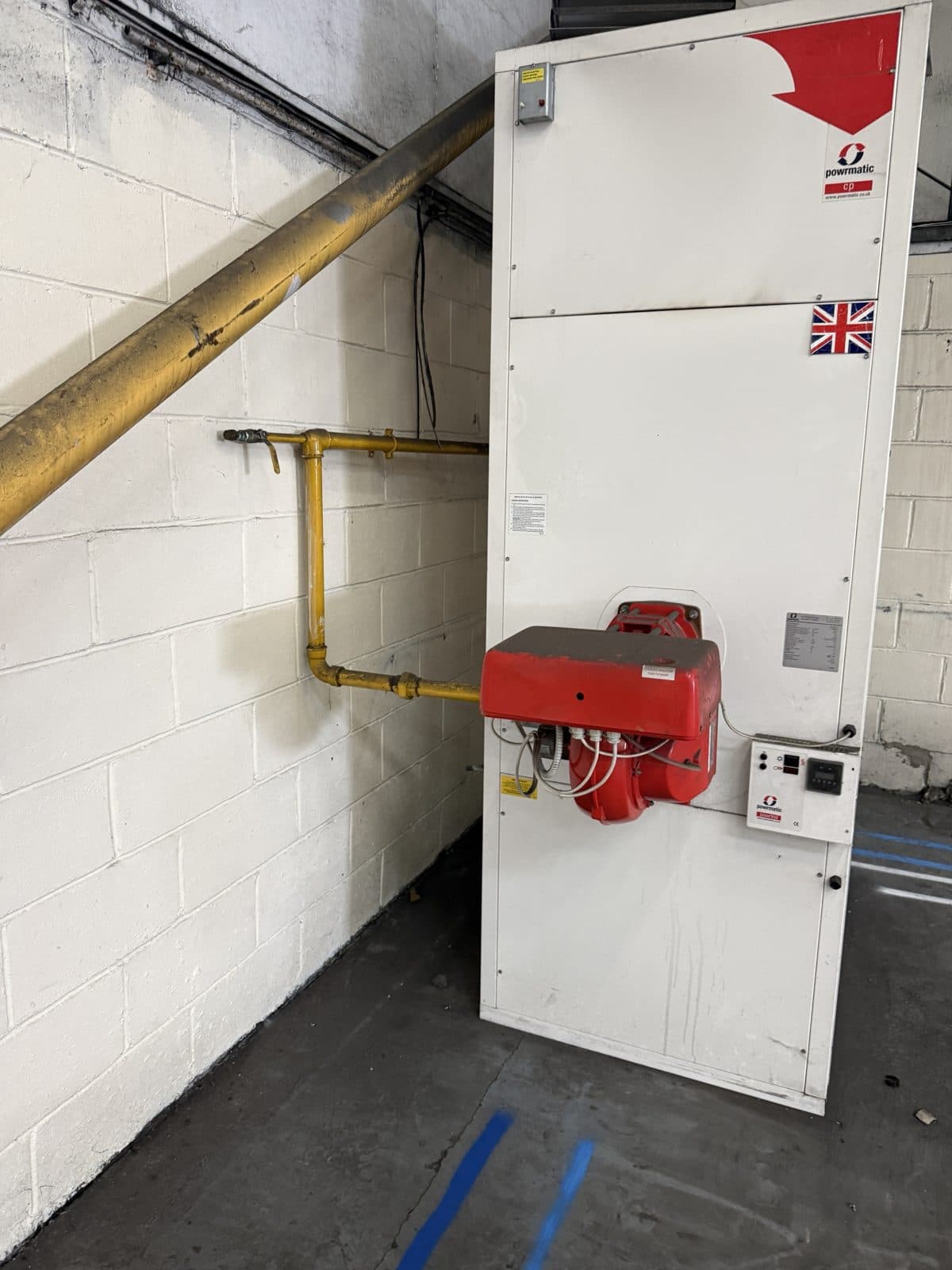
Indirect-fired heaters. The most common type. A burner heats a sealed heat exchanger, a fan blows air across it, and a flue takes the combustion products outside. They include floor-standing cabinet heaters and suspended unit heaters.
Direct-fired heaters. The combustion products mix with the heated air and go straight into the building. They're used in large, well-ventilated spaces, and they depend on that ventilation to keep the air safe.
Radiant tube and plaque heaters. Not warm air heaters, but often on the same sites. They heat people and surfaces rather than the air, and they need their own checks.
Each of these is a separate category of non-domestic gas work, so check that your engineer's Gas Safe ID card covers the type of heater you have.
What a warm air heater service should include
- Visual inspection. The casing, mountings and suspension, gas connections, and clearances. Stock and racking stacked against heaters is a common problem.
- Burner. Clean the burner and injectors, and check the ignition and flame sensing electrodes.
- Heat exchanger. Inspect for cracks, holes, corrosion and sooting. This is the single most important check on an indirect-fired heater.
- Combustion analysis. Flue gas readings, compared with the manufacturer's figures, to confirm the heater is burning safely and efficiently.
- Gas pressure and gas rate. Confirm the heater is getting the right amount of gas.
- Flue. Check the route, joints, supports and terminal, and test that the flue is clearing the combustion products.
- Safety controls. Flame protection, overheat limit thermostat, air pressure switch and fan controls are all tested to prove they shut the heater down when they should.
- Fan and motor. Bearings, belts, impeller and motor. Worn or slack belts are a common cause of overheating and lockouts.
- Filters, ducts and louvres, where fitted.
- Controls. Thermostats, time clocks, frost protection and any building management system.
- Ventilation. Combustion air for the heater, and for direct-fired heaters, ventilation of the space they heat.
- Tightness test of the gas installation.
- Written record of the results for each heater.
Warning signs to look out for
- The heater keeps locking out or won't light.
- It short cycles, switching on and off frequently.
- It blows cold or lukewarm air.
- There's a smell of fumes or burning.
- There are soot or black marks around the casing or flue.
- The fan is noisy, or a belt is squealing.
- Gas bills have gone up without a change in use.
Staff complaining of headaches, dizziness, nausea or drowsiness that ease when they leave the building can be a sign of carbon monoxide. If you suspect it, turn the heaters off, ventilate the building, get people outside, seek medical advice, and call the National Gas Emergency Service on 0800 111 999.
Never keep resetting a heater that keeps locking out. A lockout is a safety device doing its job, and repeated resets hide the fault rather than fixing it.
Why warehouse heaters fail
- Dust and debris blocking burners, fans and filters.
- Stock and racking placed too close, restricting airflow or creating a fire risk.
- Forklift damage to flues, gas pipes and heater mountings.
- Long idle summers. Bearings seize, and insects and spiders nest in burners and flues.
- Belts and bearings that are never replaced until they fail.
- Condensation and corrosion in older heat exchangers and flues.
- Controls that have been bypassed or overridden to get a faulty heater running.
Repair or replace?
Many faults are straightforward repairs: ignition and flame sensing problems, fan motors, belts, controls and gas valves. Some are not.
- A cracked or holed heat exchanger usually means replacing the heater. On most models it can't be repaired safely or economically.
- Obsolete parts. On older heaters, key parts may no longer be available.
- Efficiency. A heater that's decades old may be costing you far more to run than a modern one.
Since 2018, new gas-fired warm air heaters have had to meet Ecodesign requirements for minimum seasonal efficiency and maximum NOx emissions, and the limits were tightened in 2021. That means a modern replacement may differ in size, output or flue arrangement from the heater it replaces, so it's worth planning replacements in the summer rather than in the middle of a breakdown.
Heaters that are taken out of service must be disconnected and the gas supply capped off properly by a Gas Safe registered engineer. On a working site, this can be done in stages so the rest of the building stays heated.
Planning around your operation
- Service before the heating season. Late summer and early autumn is the ideal time.
- Work in phases so part of the building stays heated and operational.
- Agree access in advance. High-level heaters may need a scissor lift or other access equipment, and forklift traffic and site rules need to be planned around.
- Keep one set of records for all the heaters on site, with one renewal date.
How Titan Heat can help
We service, repair and safety check warm air heaters across Glasgow, Lanarkshire and Central Scotland. We also decommission and cap off old heaters, and we can include every heater on your site in a planned maintenance contract alongside your boilers and other gas equipment.
Use our commercial enquiry form to tell us how many heaters you have, what type they are and how your site operates, and we'll arrange a visit and give you a clear quote.
Frequently asked questions
How often should a warm air heater be serviced?
At least once a year, ideally before the heating season. Heaters in very dusty environments may need cleaning more often.
Do warm air heaters need a gas safety certificate?
As gas appliances at work, they must be kept in a safe condition. An annual service and safety inspection with a written record is how you prove it, and most insurers and landlords will ask to see it.
Can a cracked heat exchanger be repaired?
Usually not. On most heaters, a cracked or holed heat exchanger means the heater is unsafe to use and needs replacing.
Is it safe to keep resetting a heater that locks out?
No. A lockout means a safety device has shut the heater down. The cause needs to be found and fixed by a Gas Safe registered engineer.
Do you work on oil-fired warm air heaters?
Yes. We're OFTEC registered for oil-fired work as well as Gas Safe registered for gas.
Do you cover my area?
We work on commercial heating across Glasgow, Lanarkshire and Central Scotland.