Heating a warehouse is nothing like heating an office. The space is tall, the doors open all day, racking blocks the airflow, and the people you need to keep warm might be in one corner of a building the size of a football pitch. Pick the wrong type of heater and you can spend a fortune warming the roof while the loading bay stays cold.
This guide explains the main types of warehouse heating, how direct and indirect fired heaters differ, when oil makes sense instead of gas, what the efficiency rules mean for replacements, and how the main brands compare. It's written for owners, operations managers and facilities teams in Glasgow, Lanarkshire and Central Scotland.
The short answer
- There are two basic approaches: warm air, which heats the air in the building, and radiant, which heats people, floors and surfaces directly.
- Warm air (suspended unit heaters, floor-standing cabinet heaters and air rotation units) suits enclosed, racked buildings that need an even temperature throughout.
- Radiant tubes suit tall buildings, loading bays and draughty areas where doors are open a lot, or where only part of the building needs heating.
- Indirect-fired heaters have a sealed heat exchanger and a flue. Direct-fired heaters put the combustion products into the building, so they depend on plenty of ventilation.
- Use gas where there's a supply. Oil-fired heaters suit sites off the gas grid.
- New heaters must meet Ecodesign efficiency and emissions limits, so an old heater often can't be swapped like for like. Get the building assessed before you choose.
Start with the building, not the heater
The right system depends on how the building is used. Before looking at any product, answer these questions:
- Height. How high is the roof, and how high will the heaters be mounted? Tall buildings lose a lot of warm air to the roof space.
- Racking. Is there high or tightly packed racking? It blocks the throw of warm air and shades the floor from radiant heat.
- Doors and loading bays. How often are the doors open, and for how long? Every opening lets warm air out.
- Where people work. Are staff spread across the whole floor, or concentrated at packing benches, goods-in or a workshop corner?
- Hours. Single shift, double shift or round the clock? Intermittent use favours heating that warms people quickly.
- What you store and do. Dust, fumes, flammable materials or processes that need fresh air all affect which heaters are suitable and where they can go.
- Insulation. Older sheds with uninsulated roofs and cladding behave very differently from modern logistics units.
- Fuel and services. Is there a gas supply, and is it big enough? Is there room for flues, and an electrical supply where the heaters will go?
There's also a legal baseline. The Workplace (Health, Safety and Welfare) Regulations 1992 require a reasonable temperature in indoor workplaces, and the HSE's Approved Code of Practice says workrooms should normally be at least 16°C, or at least 13°C where the work involves a lot of physical effort. Where goods have to be kept cold, the code expects employers to take all reasonable steps to keep people as close to comfortable as they can, for example with heated work areas.
Warm air heating
Warm air heaters burn gas or oil to heat a heat exchanger, and a fan blows air across it into the building. They're widely used in warehouses, factories and workshops, and they come in three main forms.
Suspended unit heaters
Overhead units hung from the roof steel or mounted on a wall, blowing warm air across or down into the space. They're compact, keep the floor clear and suit buildings of most sizes. Outputs run from small units for a workshop to well over 100 kW per heater. Powrmatic's LNVx suspended range, for example, runs from 14.5 kW to 137 kW.
The weakness is height. Warm air rises, so in a tall building a lot of the heat ends up under the roof. Mounting height, air throw and louvre direction all matter, which is why heaters need positioning properly rather than hanging wherever there's a convenient bit of steel.
Floor-standing cabinet heaters
Larger heaters that stand on the floor or a plinth, usually in a corner or along a wall. They blow air out through directional nozzles, or connect to ductwork that carries warm air across the building. Cabinet heaters range from around 30 kW to several hundred kilowatts each, and some models can be sited in a plant room or outdoors. They suit large open buildings and sites where a few big heaters make more sense than lots of small ones.
They take up floor space and need protecting from forklifts, and ducted systems need the ductwork designing properly to get the air where it's needed.
Air rotation units
A newer approach for big, tall buildings. Air rotation units are large floor-standing heaters with powerful fans that move huge volumes of air through the building at a relatively low temperature. Because they keep the whole volume of air moving, they reduce the layer of hot air that builds up under the roof with other warm air systems. They suit large distribution centres and high-bay racked buildings.
Direct-fired or indirect-fired?
Most warm air heaters are indirect-fired. The burner fires into a sealed heat exchanger, the heated air never touches the flame, and the combustion products go outside through a flue. This is the safe default for an enclosed building where people work.
Direct-fired heaters burn gas in the airstream itself, so the combustion products enter the building with the heated air. With no flue losing heat, almost all the energy goes into the space. The trade-off is ventilation. Direct-fired heaters rely on a continuous supply of fresh air to keep the air in the building safe, so they're used where large amounts of fresh air are needed anyway, such as make-up air for extraction systems or very large, well-ventilated spaces. The installation standard for both types, BS 6230, sets out the ventilation requirements.
If someone proposes direct-fired heating for an enclosed warehouse, ask how the ventilation will be provided and controlled, and what happens if the ventilation fans stop.
Radiant heating
Radiant heaters work like the sun. They warm the people, floors and racking they shine on, rather than the air in between. Because the heat isn't carried by the air, less of it is lost when doors open or when warm air rises to the roof, and the air temperature in a radiant-heated building can be lower while people still feel comfortable.
Radiant tube heaters
A burner fires down a steel tube, which gets hot and radiates heat, and a reflector above the tube directs that heat downwards. Tubes come as straight linear units or U-tubes, hung from the roof at a height the manufacturer sets for each heater's output.
For very large buildings there are continuous systems, where one long run of tube has several burners along it and a single fan at the end draws the combustion products out. These are designed around the individual building, with tube runs ranging from tens of metres to more than 200 metres.
Flued and unflued radiant tubes
Radiant tubes can be flued to outside, or installed unflued so the combustion products discharge high up inside the building. Unflued installations need enough natural or mechanical ventilation to clear those products. The installation standard for overhead radiant heaters, BS 6896, covers this, and the manufacturer's instructions give the figures for each model.
Luminous plaque heaters
Plaque heaters burn gas across a ceramic surface that glows red hot. They give intense heat and suit spot heating of workstations, open-sided buildings and very draughty areas. They're normally unflued, so ventilation is essential.
Where radiant works best
- Tall buildings where warm air would stratify under the roof
- Loading bays, goods-in areas and buildings with doors open much of the day
- Buildings where only some areas are occupied, since tubes can be zoned and controlled separately
- Workshops and vehicle bays where people work in fixed positions
Radiant is weaker where dense racking shades the floor, because the heat only warms what the tube can see. Racking and stock also have to be kept outside each heater's minimum clearances, which can limit what you store at height.
Warm air vs radiant at a glance
- Suspended warm air unit heaters. How it heats: Heats air, fan-blown from overhead. Best for: Enclosed buildings of most sizes, workshops, racked warehouses. Watch out for: Heat stratifying under tall roofs; needs careful positioning.
- Floor-standing cabinet heaters. How it heats: Heats air, through nozzles or ductwork. Best for: Large open buildings; sites wanting a few large heaters. Watch out for: Floor space, forklift protection, duct design.
- Air rotation units. How it heats: Moves large volumes of low-temperature air. Best for: Large, tall distribution centres and high-bay racking. Watch out for: Large units, best designed in from the start.
- Direct-fired warm air. How it heats: Combustion products go into the heated air. Best for: Large, well-ventilated buildings that need fresh air. Watch out for: Depends on ventilation; unsuitable for most enclosed spaces.
- Radiant tubes. How it heats: Heats people and surfaces directly. Best for: Tall buildings, loading bays, draughty or part-occupied spaces. Watch out for: Shading by racking; clearances; ventilation if unflued.
- Luminous plaque heaters. How it heats: Intense radiant heat. Best for: Spot heating, open-sided or very draughty areas. Watch out for: Normally unflued, so ventilation is essential.
Stratification, doors and controls
Whatever heaters you choose, three things decide how much you actually spend.
- Stratification. In a tall building heated by warm air, the air under the roof can be far hotter than the air at floor level. Destratification fans push that warm air back down to where people work. Air rotation units do a similar job as part of how they operate.
- Doors. Fast-acting doors, strip curtains or air curtains over busy doorways cut the heat lost every time a door opens.
- Controls. Zoning, time control, optimum start and frost protection stop you heating empty areas or an empty building. Radiant systems need the right sensor, usually a black bulb sensor, because an ordinary air thermostat doesn't measure what people actually feel under radiant heat.
Gas, oil, LPG or electric?
Natural gas is the usual choice where there's a supply, and it offers the widest range of heaters. A new or bigger heating system may need a larger meter or upgraded pipework, so check the supply early in the project.
Oil-fired heaters are the answer on sites off the gas grid, which is common on rural industrial estates, farms and estates across Lanarkshire, Stirlingshire and Perthshire. Several manufacturers make oil-fired warm air heaters, including air rotation units. Oil needs a storage tank that meets Scotland's oil storage rules, and oil burners need regular servicing to keep nozzles, filters and combustion right. Our guide to commercial oil boiler servicing covers the storage rules in more detail.
LPG versions of many gas heaters are available where there's no mains gas but oil isn't wanted. LPG work needs an engineer qualified for LPG.
Electric options, from electric warm air units to electric radiant panels, avoid combustion altogether and can make sense for small or occasionally used areas. Electricity usually costs more per kWh than gas, so compare running costs for your site before choosing it for a whole building. Air source heat pumps are also starting to appear in warehouses, mostly in well-insulated modern buildings, and need careful design for tall, draughty spaces.
What the efficiency rules mean for new and replacement heaters
Since 2018, new warm air and radiant heaters sold in the UK have had to meet Ecodesign requirements for minimum seasonal efficiency and maximum NOx emissions. For warm air heaters, the second stage in 2021 raised the minimum seasonal efficiency to 78% and cut the NOx limit to 70 mg/kWh. Gas-fired radiant heaters have their own requirements, including a minimum seasonal efficiency of 74%.
In practice this means:
- An old heater often can't be replaced like for like. The modern equivalent may have a different output, size, burner or flue arrangement.
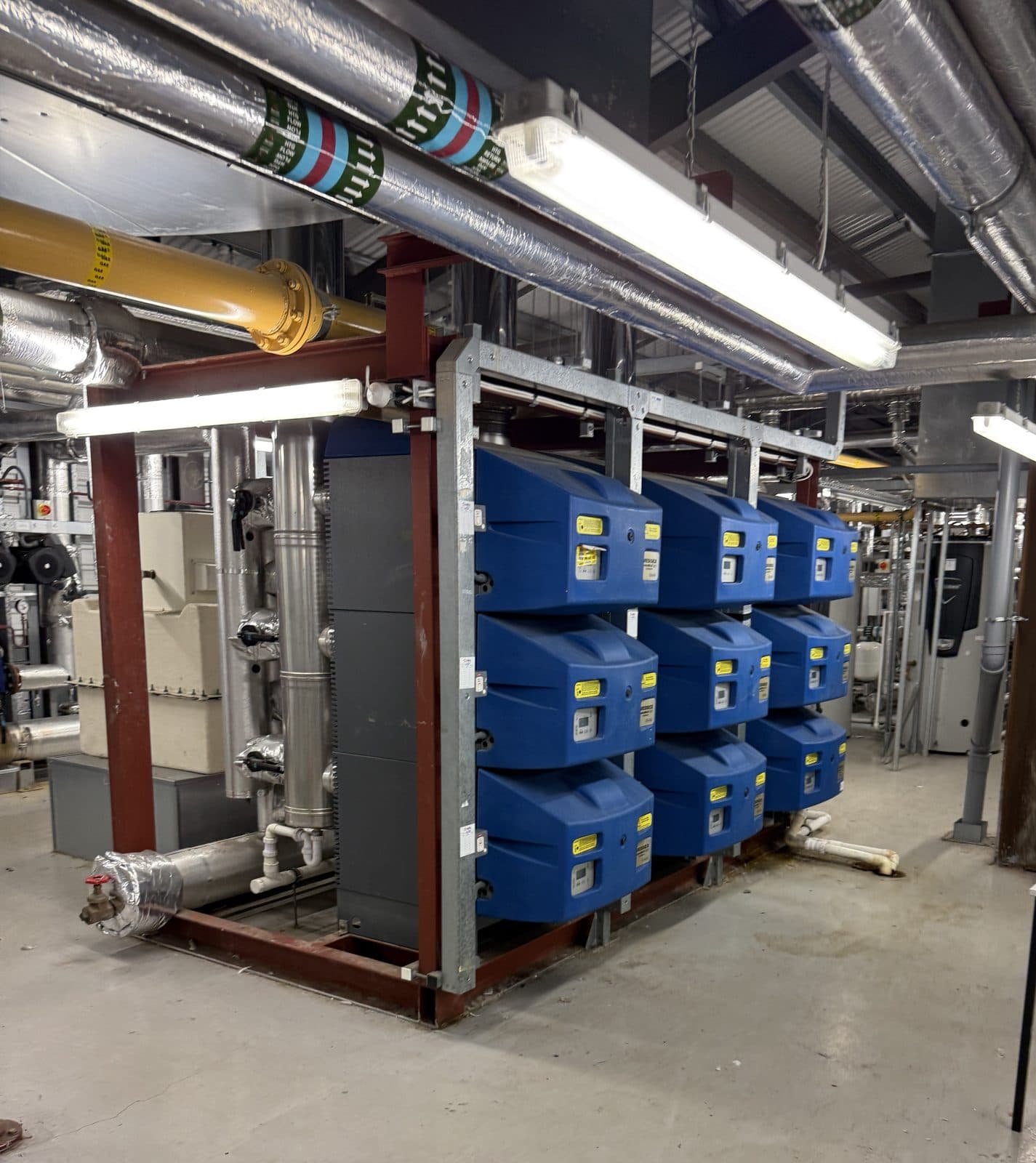
- Many modern heaters use modulating burners, and some are condensing. Condensing heaters need a condensate drain, which has to be planned in.
- A replacement is a good moment to rethink the system. The building may have changed since the original heaters went in, with new racking, new doors or a different use.
If your heaters carry a brand you don't recognise any more, several well-known names have merged over the years. Benson heaters, for example, now sit within the Nortek Global HVAC group alongside Reznor and AmbiRad, so parts and technical support for older Benson units come through that group. Parts for very old heaters can still be scarce, and that often settles the repair-or-replace question.
Powrmatic vs the other main brands
These are the manufacturers you're most likely to come across on warehouse sites. All of them make heaters that meet the same efficiency rules, so the choice usually comes down to the right product for the building, parts and support, and how well a new heater fits what's already there.
Powrmatic
A British manufacturer of warm air heating, with a range that covers most warehouse needs:
- LNVx suspended unit heaters, 14.5 kW to 137 kW, natural gas as standard with LPG as an option
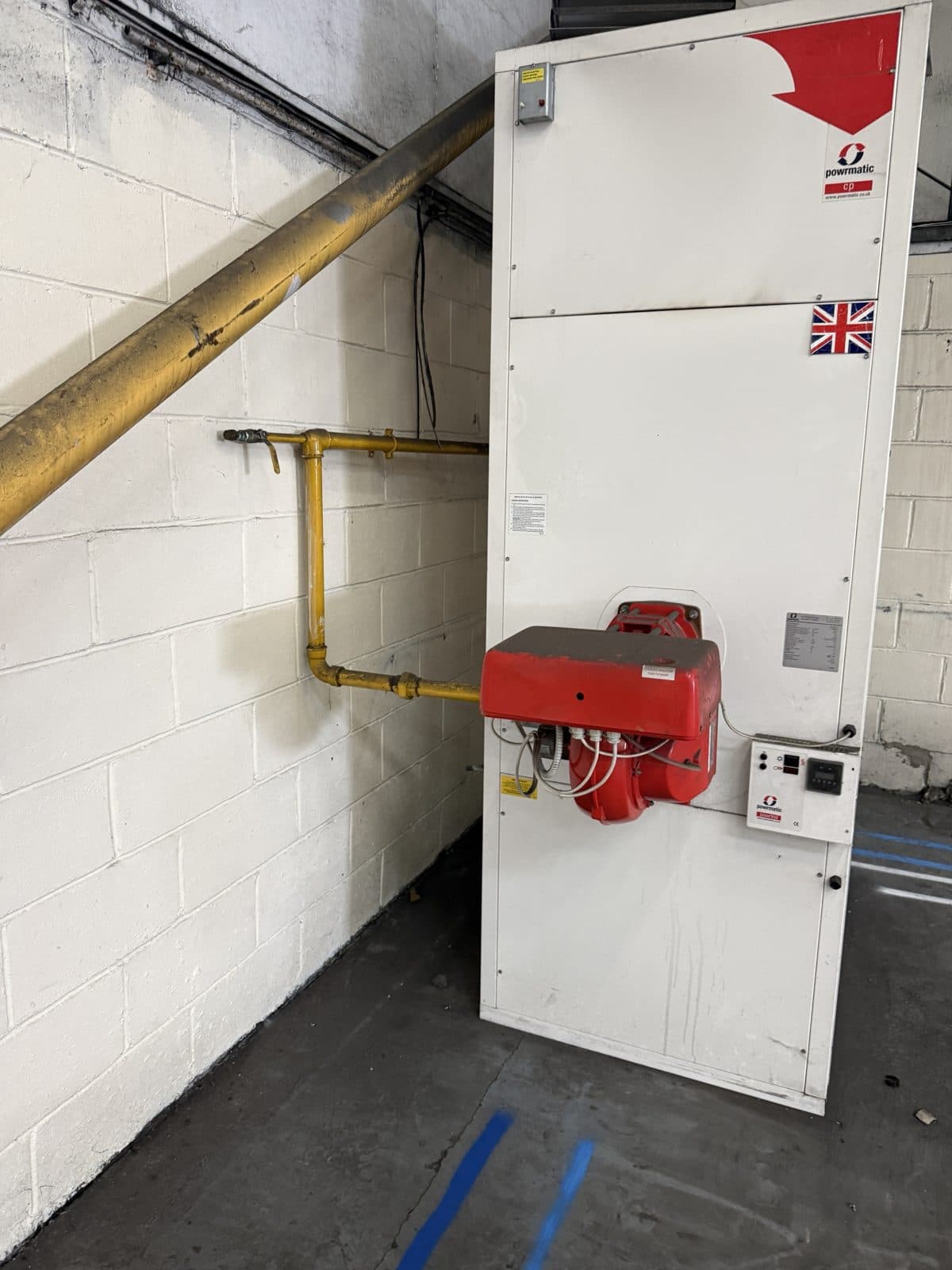
- VX cabinet heaters, 35 kW to 140 kW, configurable as room-sealed or flued, for vertical or horizontal installation
- CX floor-standing cabinet heaters, 30 kW to 300 kW, free-blowing or ducted, with external versions available
- CPx large cabinet heaters, 360 kW to 590 kW, which can be sited in the heated space, in a plant room or outdoors
- TEx air rotation heaters, gas or oil fired
Powrmatic's strength is breadth in warm air: one British manufacturer covering everything from small workshop units to very large cabinet and air rotation heaters. Its own published guidance favours warm air for most racked warehouses, which is worth weighing with the fact that warm air is what it makes.
Reznor, AmbiRad and the Nortek group
Nortek Global HVAC brings together several long-established brands, including Reznor warm air heaters, AmbiRad radiant tube heaters, Benson heaters, Nordair Niche air rotation and direct-fired units, and continuous radiant tube systems. The appeal is that one group covers warm air, radiant, air rotation and air curtains, so a mixed system, such as warm air over the racking and radiant tubes over the loading bays, can come from one manufacturer.
Winterwarm
A Dutch manufacturer known for condensing unit heaters with fully modulating burners. Several of its models appear on the UK government's Energy Technology List, with seasonal efficiencies of around 89 to 90%.
Other names you'll see
Space-Ray, part of the Gas Fired Products group, makes radiant tube and plaque heaters in the UK and the US, and you'll find a range of other European radiant and warm air brands on older and newer sites. Whatever the badge, we'll tell you straight whether an existing heater is worth keeping.
How to choose between brands
- The right product first. The type of heater matters more than the badge. Decide on warm air, radiant or a mix, then compare models.
- Parts and support. Ask how quickly common parts are available and who provides technical support.
- Fit with what's there. A heater that suits the existing gas connection, flue route and mounting points can save a lot of installation cost.
- Controls. Check the heater works with the controls or building management system you want to use.
- Warranty conditions. Most warranties depend on professional commissioning and annual servicing.
- Efficiency. Compare seasonal efficiency figures, not just peak output.
What good warehouse heating design covers
Good heating design is mostly about getting heat to the right places. A proper design should cover:
- Heat demand. How much heat the building needs, based on its size, construction, insulation, air leakage and doors, and the temperatures you need in each area.
- Heater type and layout. Which type of heater goes where, at what mounting height, and how the air throw or radiant pattern covers the working areas.
- Gas or oil supply. Whether the existing meter and pipework can carry the extra load, and the pipe sizes for any new runs.
- Flues and ventilation. Flue routes, terminal positions and the ventilation the heaters need, in line with BS 6230 for warm air heaters or BS 6896 for overhead radiant heaters, and the manufacturer's instructions.
- Clearances. Distances to racking, stock, sprinklers, lighting and cranes, and protection from forklifts.
- Controls and zoning. Which areas are controlled separately, where sensors go, and time and frost control.
- Access for maintenance. Heaters high in the roof still need servicing every year, so plan how they'll be reached.
For larger buildings, manufacturers will also produce layouts and calculations for their own products, which make a useful cross-check on the design.
Replacing old heaters without disrupting the site
- Plan in the summer. Replacing heaters during a cold snap means choosing in a hurry. Survey and order in the warmer months.
- Work in phases. On a working site, heaters can be replaced area by area so the rest of the building stays heated.
- Cap off what you remove. Old heaters must be disconnected and the gas supply capped off properly by a Gas Safe registered engineer.
- Commission and record. New heaters need commissioning to the manufacturer's figures, with combustion readings and safety checks recorded.
- Book the first service. Put new heaters on an annual service from day one to protect the warranty.
Check your engineer is qualified for your heaters
Commercial heaters are separate categories of gas work. A Gas Safe registered engineer's ID card lists exactly what they're qualified to work on, and you can check it on the Gas Safe Register website. For warehouse heating, look for:
- CIGA1 for indirect-fired heaters, including warm air heaters and commercial boilers
- CDGA1 for direct-fired heaters
- CORT1 for overhead radiant tube and luminous plaque heaters
- OFTEC registration for oil-fired heaters
Our lead engineer, Stephen, holds all three commercial heater categories, and Titan Heat is OFTEC registered for oil.
How Titan Heat can help
We design, install, replace, service and repair warehouse heating across Glasgow, Lanarkshire and Central Scotland.
- Design and advice. A site visit to look at the building, how it's used and what's there now, followed by a recommendation on the type of heating, layout and controls.
- Supply and installation. Warm air and radiant heaters, with the gas pipework, flues and controls that go with them. We'll quote more than one manufacturer where it makes sense.
- Replacements. Planned, phased replacement of old or failed heaters, including capping off and removing the old units.
- Servicing. Annual servicing and safety checks for warm air, radiant tube and plaque heaters. See our guide to warm air heater servicing.
- Repairs. Fault-finding and repairs on gas and oil-fired heaters, including older models.
- Planned maintenance. Every heater on your site on one maintenance contract, alongside boilers and other gas equipment.
Tell us about your building through our commercial enquiry form: its size and roof height, the heaters you have now and how the site operates. We'll arrange a visit and give you a clear quote. You can also see how we work with warehouses and distribution centres.
Frequently asked questions
Is radiant or warm air heating cheaper to run in a warehouse?
It depends on the building. Radiant tends to win in tall, draughty buildings and loading bays, and where only part of the space is occupied, because it heats people rather than air. Warm air, especially with destratification fans or air rotation, tends to suit enclosed, racked buildings that need an even temperature throughout. A survey of your building is the only honest way to answer it.
What's the difference between direct and indirect fired heaters?
Indirect-fired heaters burn fuel inside a sealed heat exchanger and send the combustion products outside through a flue. Direct-fired heaters put the combustion products into the heated air, so they depend on plenty of ventilation and suit large, well-ventilated spaces.
Can I replace my old warm air heater like for like?
Often not exactly. Ecodesign rules set minimum efficiency and maximum emissions for new heaters, so the modern equivalent may differ in size, output or flue arrangement. We match the replacement to your existing gas, flue and mounting arrangements wherever we can.
How high should radiant tube heaters be mounted?
Each manufacturer sets minimum mounting heights based on the heater's output, to keep the heat comfortable at floor level and maintain safe clearances. Higher-output tubes need to go higher.
Can you heat just part of a warehouse?
Yes. Radiant tubes are well suited to zoning, such as heating a packing area or goods-in without heating the whole building. Warm air systems can be zoned too, with separate controls for different areas.
Do warehouse heaters need servicing every year?
Yes. They're gas or oil appliances in a workplace, so they must be kept in a safe condition, and an annual service with a written record is how you show it. Most manufacturers' warranties also depend on annual servicing.
Do you work on Powrmatic heaters?
Yes. We service, repair and install Powrmatic heaters, along with the other main brands of warm air and radiant heaters.
Do you cover my area?
We work on commercial heating across Glasgow, Lanarkshire and Central Scotland.