Before anyone lights an appliance in a new restaurant, an industrial unit or an altered boiler room, the gas pipework has to be designed, installed, strength tested, tightness tested and purged. Each of those steps follows an IGEM procedure, and the size and pressure of the installation decide which one applies. What the building is used for doesn't come into it.
This guide is for facilities managers, contractors, restaurant owners and commercial landlords. In Glasgow the job might be a tenement shop unit becoming a restaurant, with old steel pipe in the basement. In Lanarkshire it is more often a steel-framed unit with long large-bore runs to warm air or radiant heaters. The rules are the same in both, but the test method often isn't.
The short answer
- The installation decides the test standard, not the building. IGEM/UP/1B covers small installations up to 0.035 m³. IGE/UP/1A covers low-pressure natural gas installations up to 1 m³, 150 mm pipe and 40 mbar. Anything larger or at higher pressure goes to IGE/UP/1.
- New pipework goes through three steps: a strength test, a tightness test at operating pressure, then a direct purge. Existing pipework gets a let-by check and a tightness test but isn't normally strength tested.
- New pipework must show no measurable leak. Existing pipework may be allowed a small calculated drop, but a smell of gas is a fail whatever the gauge says.
- The law requires testing after any work that could affect gas tightness, and purging before gas is used (Gas Safety (Installation and Use) Regulations 1998, regulations 6 and 22).
- You should receive a written test and purge record, and the engineer's Gas Safe card should list the non-domestic pipework and testing categories the job needs.
Which tightness test standard applies?
IGEM (the Institution of Gas Engineers and Managers) publishes three procedures. The engineer picks one based on the fuel gas, the operating and supply pressures, the largest pipe size and the installation volume. Installation volume is the internal volume of the pipework, plus the meter where it is included in the test.
- IGEM/UP/1B (Edition 4). Covers: Tightness testing and direct purging of small installations, domestic or non-domestic. Main limits: Up to 0.035 m³; pipe up to 35 mm; meter up to 16 m³/h; natural gas at up to 21 mbar.
- IGE/UP/1A (Edition 2). Covers: Strength testing, tightness testing and direct purging of small, low-pressure commercial installations. Main limits: Natural gas only; up to 1 m³ including meter and fittings; pipe up to 150 mm; up to 40 mbar, on a supply of up to 75 mbar.
- IGE/UP/1 (Edition 2). Covers: Strength testing, tightness testing and direct purging of industrial and commercial installations. Main limits: Anything beyond UP/1A, up to 16 bar, natural gas, LPG and other fuel gases.
There are three procedures because a leak is harder to see on a gauge in a large volume of pipework, and higher pressures store more energy if something fails. In practice, 0.035 m³ is small: a 16 m³/h meter with about nine metres of 35 mm copper reaches it. A small café can fall under UP/1B, but most restaurants, plant rooms and industrial units are tested to UP/1A or UP/1. 1 m³ is large by comparison, roughly 100 metres of 100 mm steel. Big sites with long large-bore mains, or anything on a medium-pressure supply, move to UP/1.
IGEM/UP/1B Edition 4 became mandatory on 1 October 2026. It sets permitted pressure drops by installation volume rather than meter size alone. UP/1 and UP/1A are still at Edition 2 (2005 amendments). Testing of meter installations is covered separately by IGEM/UP/1C.
Strength, tightness and let-by tests explained
Strength test: will it hold together?
New pipework and extensions are strength tested first, with meters and pressure switches blanked off. The pipework is pressurised well above its working pressure, usually with air, to find major faults and prove it can take the highest pressure it could see if the meter regulator failed. On a typical UP/1A job the test pressure is 82.5 mbar or 2.5 times the maximum operating pressure, whichever is higher, held for five minutes after a five-minute settle. Higher-pressure systems need higher pressures and longer tests, with exclusion zones above 1 bar and sometimes a water test. Existing pipework isn't normally strength tested.
Tightness test: is it leaking?
The tightness test is carried out at operating pressure. The pipework is isolated, pressurised and allowed to stabilise, because temperature changes move the gauge, then watched for a set time. New pipework must show no measurable drop. For existing pipework a small calculated drop may be allowed, as long as there is no smell of gas. In principle, that allowance depends on four things:
- Installation volume. The same leak gives a smaller pressure drop in a bigger system, so large installations need longer tests or finer gauges.
- Where the pipe runs. The limit is set so a leak could not build up a dangerous gas concentration. Pipe in a small or poorly ventilated room gets far less allowance than pipe outdoors or in a large ventilated building.
- Gauge readability. A water gauge reads to about 0.5 mbar. A two-decimal electronic gauge reads to 0.1 mbar, so it spots the same leak in less time.
- Test duration. Under UP/1A it comes from tables. Under UP/1 it is calculated and can run to an hour or more, and long tests are corrected for changes in atmospheric pressure.
Let-by test: does the valve shut off?
Before testing existing pipework on gas, the engineer checks that the valve feeding it, usually the emergency control valve (ECV), is actually stopping the gas. If pressure creeps up with the valve closed, gas is getting past it and the tightness test would mean nothing. A faulty ECV is generally the gas network's responsibility, which in Scotland means SGN.
Purging: getting the air out safely
Freshly tested pipework is full of air, or an air and gas mix, and lighting appliances on it is dangerous. Regulation 22 requires purging immediately after the tightness test, and gas must not be let into untested, unpurged pipework.
Direct purging uses the fuel gas itself to push the air out, fast enough that the two don't mix. The engineer calculates a purge volume (about 1.5 times the installation volume, plus the meter and hose), a minimum flow rate and a maximum purge time. If that flow can't be reached, nitrogen is used instead (an indirect purge). A safe commercial purge includes:
- A planned sequence of purge points, with the responsible person told and the area ventilated
- No smoking, hot work or other ignition sources nearby, with warning notices up
- A hose or vent stack to open air, typically at least 2.5 metres up and 5 metres downwind of any ignition source, usually through a flame arrestor
- A calibrated gas detector at the outlet. The purge is complete at 90% gas, and that reading is recorded
- Purge points capped and leak-checked, then each appliance lit and checked for a stable flame
Purge points belong at the end of each main run and spur. That is a design decision, so it shouldn't be left until commissioning day. When pipework is taken out of service the purge runs the other way, from gas to air, before the pipe is capped and labelled. See our guide to capping off and decommissioning gas pipework.
If you smell gas: open doors and windows, don't use electrical switches or anything that could make a spark, and turn the gas off at the emergency control valve if it is safe to reach. Get everyone out and call the National Gas Emergency Service on 0800 111 999. Don't turn the gas back on until a Gas Safe registered engineer has found and fixed the leak.
When does commercial gas pipework need testing?
The law requires a test immediately after any work that might affect gas tightness. In practice that means:
- New installations and extensions: strength test, tightness test and purge before first use
- Alterations: moving an appliance, adding a branch or removing redundant pipe
- Before work starts on existing pipework, and whenever an escape is suspected
- Turning gas back on after it has been off or capped, once the pressure has fallen away
- After a failed smart or replacement meter installation. The pipework has to be traced, repaired and retested. See smart meter gas tightness test failed
- Change of occupier or landlord handover. This isn't a legal trigger, but landlords and insurers often want a record, and the new occupier takes on the duty to keep the installation safe
- Insurer or lease requirements
- Annual inspection. A tightness test is part of a routine commercial gas safety inspection, the usual way to show the installation is maintained safely under regulation 35
Designing commercial gas pipework to IGEM/UP/2
A test proves pipework is sound on the day. Design decides whether it works at full load and can be maintained safely. The standard is IGEM/UP/2, now at Edition 4 (2025), which applies to new work.
Pipe sizing
Pipework is sized so the pressure loss from the meter to the furthest appliance, with everything running, stays within the design limit, typically 1 mbar on a standard low-pressure supply. Undersized pipe shows up as appliances that work alone but struggle when the whole kitchen is on. Before extending, check that the existing pipe and meter can carry the extra load.
Materials
- Carbon steel. Typical use: Mains, plant rooms, large bore. Points to know: Screwed on smaller sizes; new steel above 50 mm is welded or flanged.
- Copper. Typical use: Smaller runs and connections. Points to know: Brazed, not soft soldered, above 75 mbar.
- Press-fit (copper or stainless). Typical use: Quick installs in occupied buildings. Points to know: Permitted with gas-specific fittings and seals (usually yellow, never black water seals) to BS 8537, the correct press tool, and up to 5 bar.
- Polyethylene (PE). Typical use: Buried runs between buildings. Points to know: External and underground only; changes to metal at the building entry; never solvent welded.
- Corrugated stainless (CSST). Typical use: Awkward routes. Points to know: Sized and installed to the manufacturer's system only; not the final appliance connection.
Routing, valves and labelling
- Sleeving: through walls and floors by the shortest route, normally in a sleeve sealed at one end. Pipe may cross a cavity but not run inside it (regulation 19), and ducts or voids must be ventilated.
- Support and protection: correct clip spacing, protection from forklifts and corrosion, and at least 150 mm from electricity meters and switchgear.
- Emergency control: an accessible ECV where the supply enters, marked open and shut, with an escape notice if it isn't beside the meter (regulation 9). If the meter is remote, an additional emergency control valve (AECV) goes at the building entry.
- Isolation valves: one for each area (kitchen, boiler room), one at every appliance inlet, and one at any branch of 50 mm or more, with test and purge points alongside.
- Marking: outside dwellings, gas pipe must be permanently marked (regulation 23), usually yellow ochre paint or banding. Larger buildings need a line diagram fixed near the meter showing pipework, valves and test points (regulation 24).
Meter rooms
The meter itself is arranged through your gas supplier, so raise any supply upgrade early. The space around it is your responsibility. An external meter box or compound must vent leaking gas to open air, not into the building, and nothing easily ignited should be stored in it (regulation 13). Keep meter rooms ventilated, clear and accessible.
Catering interlocks
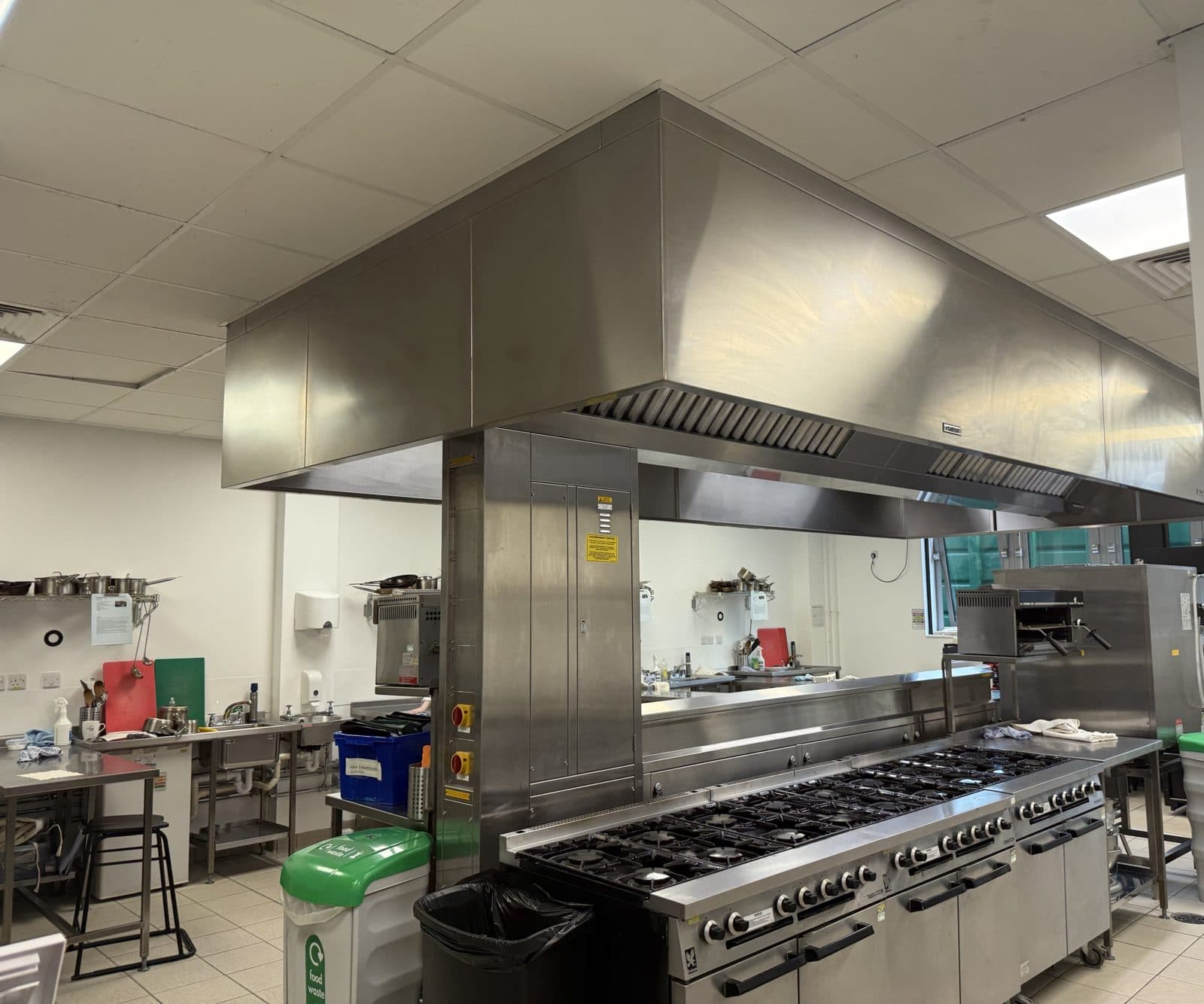
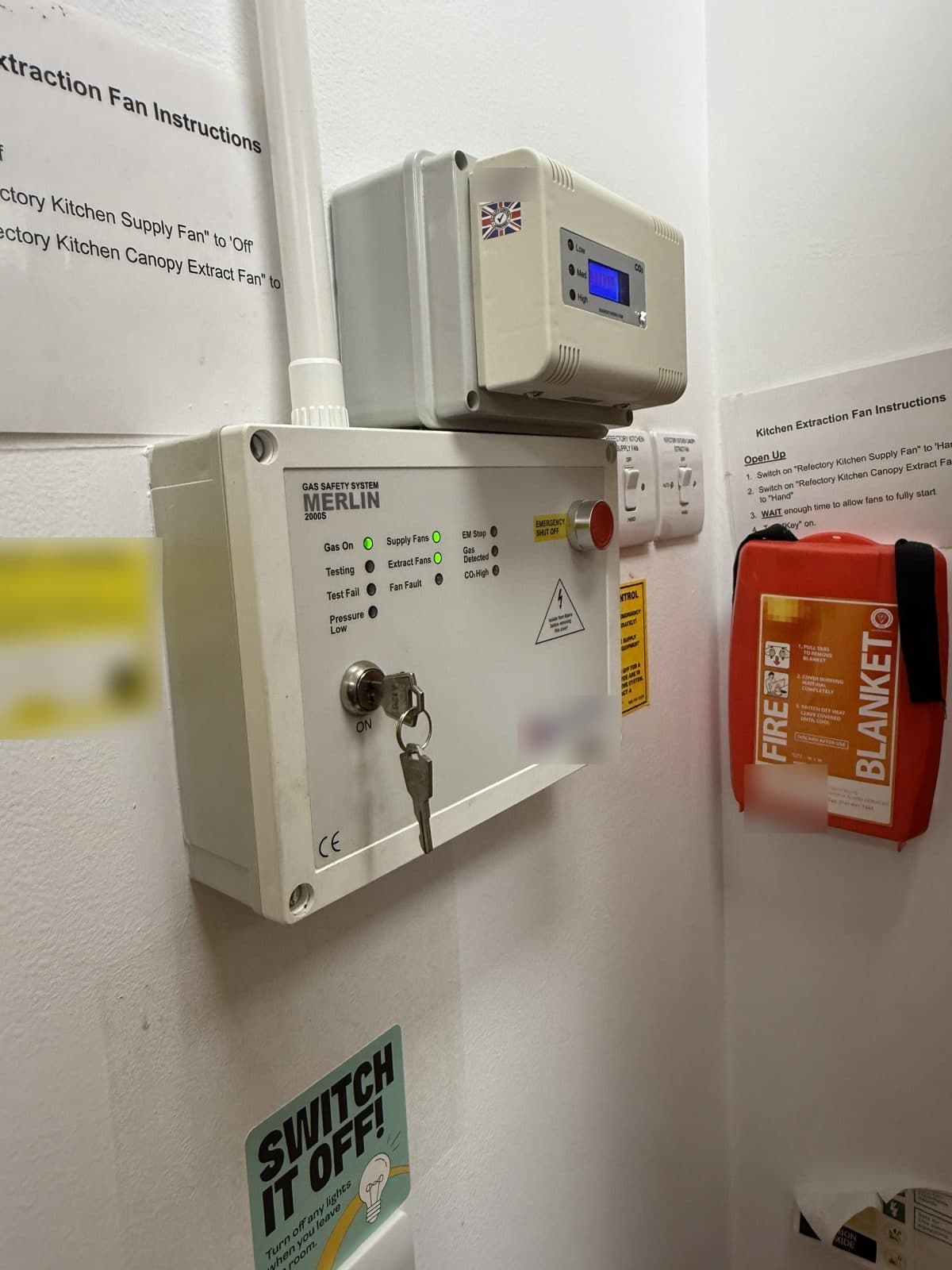
Where a kitchen has mechanical extraction, the gas supply to the cooking line is normally interlocked with the fans (BS 6173, with design guidance in IGEM/UP/19). A solenoid valve closes the gas if extraction fails. A proving system checks that the pipework is holding pressure before gas is let back in. Plan the valve position and a test point into the pipework from the start. Electrical work is done through our approved, separately registered contractor. For the annual inspection, see our commercial kitchen gas safety certificate (CP42) guide.
Gas for a new restaurant or unit: the usual sequence
- Survey and load: list every appliance and its heat input, then check the meter and supply.
- Design: size the pipework and plan the route, valves, purge points and interlock position.
- First fix: install while walls and ceilings are open, leaving joints exposed and unpainted until they have been tested.
- Strength and tightness test: to UP/1B, UP/1A or UP/1 as the installation requires.
- Purge and commission: purge to gas, then connect and commission appliances and prove the interlock. Stephen holds commercial catering gas qualifications, so the appliance connection and commissioning can be done by the same engineer as the pipework.
- Handover: test and purge records and an updated line diagram for the handover file.
In older Glasgow buildings, any existing pipe that stays in use should be tested before anything new is connected to it.
What paperwork you should receive
You should get a written testing and purging record. For non-domestic work this is often a CP16. It should show:
- The section tested and the procedure used (UP/1B, UP/1A or UP/1)
- The installation volume, operating pressure and gauge used
- Strength test pressure and result, for new work
- Let-by and tightness test times, the pressure change or calculated leak rate, and pass or fail
- The purge volume, purge points and end-point reading
- The engineer's name, the Gas Safe registration number and the date
Keep it with your gas safety records, because insurers, landlords and the next engineer may all ask for it.
Who can install, test and purge commercial gas pipework?
Gas work must be done by a Gas Safe registered business, and a business that has gas work done at its workplace must take reasonable steps to check that. Registration alone isn't enough for commercial pipework. The back of the engineer's Gas Safe ID card lists what they are qualified to do, and it should show non-domestic pipework and testing and purging. The relevant qualifications are:
- ICPN1: installing commercial gas pipework above 35 mm
- TPCP1A: tightness testing and direct purging of natural gas installations up to 1 m³, 150 mm and 40 mbar (the UP/1A range)
- TPCP1: testing and purging of larger or higher-pressure installations to IGE/UP/1, up to 16 bar on natural gas
Stephen holds all three. He also holds the commercial core qualification and the categories for commercial direct-fired and indirect-fired heating appliances and overhead radiant heaters.
How Titan Heat can help
Titan Heat installs, tests and purges commercial natural gas pipework across Glasgow, Lanarkshire and Central Scotland. That includes restaurant fit-outs, plant room alterations and bringing capped-off units back into use. We test to UP/1B, UP/1A and UP/1, trace and repair leaks, and leave a full written record. Gas Safe business registration 982732.
Main contractors can bring us in as the gas sub-contractor. Facilities managers and landlords can book testing at handover or after alterations. See our commercial heating services and our work for restaurants, bars and hotels.
Send your drawings or appliance list through our commercial enquiry form and we'll come back to you with a quote.
Frequently asked questions
What is a commercial gas tightness test?
It is a pressure test proving commercial gas pipework isn't leaking. The pipework is isolated, pressurised to operating pressure, allowed to stabilise and watched on a sensitive gauge. New pipework must show no measurable drop. Existing pipework may be allowed a small calculated drop if there is no smell of gas.
What is the difference between IGEM/UP/1 and IGEM/UP/1A?
UP/1A is a simpler, table-based procedure for low-pressure natural gas installations up to 1 m³, 150 mm pipe and 40 mbar. UP/1 covers everything beyond that, up to 16 bar and other fuel gases. It uses a calculated maximum permitted leak rate.
How long does a commercial gas tightness test take?
The test itself can take two minutes on a small installation with a sensitive gauge, or an hour or more on large pipework under UP/1. Stabilisation, strength testing and purging all add time, so plan the gas being off for a quiet period.
Does existing gas pipework need a strength test?
Not normally. Strength tests are for new pipework and extensions. Existing pipework is only strength tested for a valid reason, and after a risk assessment shows it is safe to do. It is still tightness tested.
Can press-fit fittings be used on commercial gas pipework?
Yes, as long as they are gas-specific press fittings to BS 8537, usually marked yellow, installed with the manufacturer's tool and used within their 5 bar limit. Water press fittings with black seals must never be used on gas.
What certificate do I get after gas testing and purging?
You should get a written testing and purging record, often a CP16 for commercial work. It shows the procedure, the installation volume, the test results, the purge details and the Gas Safe registration number.